
Introduction
When we speak about the traditional pioneers of Indian Science, Dr Kamal Ranadive is a name that stands out. She was more than just a quiet woman in a laboratory; she was a visionary whose impact had remodeled cancer research in India and inspired generations of women to enter the world of science. Dr Ranadive was born in 1917 and came of age at a time when it was unusual for a woman to seek higher education in her native India. She made her own way in a male dominated field.
This piece examines her life, her research, and her legacy through 10 incredible facts that prove Dr. Kamal Ranadive is not to be forgotten.
WHO WAS DR. KAMAL RANADIVE?
Dr Kamal Ranadive, an early biomedical researcher known for seminal research on the cancer virus relationship at some of the world’s leading medical schools, was from India. She obtained a PhD in cytology (under Dr V R Khanolkar) and subsequently became head of cancer biology research at the Indian Cancer Research Centre (ICRC) in Mumbai. Her career was about more than just academic accomplishment: It was about establishing institutions, training young scientists, and ensuring that scientific research benefited those who needed it most.
Dr. Kamal Ranadive’s education and early life
Dr Kamal Ranadive, hailing from Pune, was born in a middle class Maharashtrian family. Her father, a biology professor, played a crucial role in cultivating her interest in science. In a society where many families favored securing a marriage over higher studies for their women, her father pressed her to pursue education.
She graduated in science from Fergusson College and obtained her master’s degree in Botany from the University of Bombay. But her true academic leap happened when she made the switch to cytology and cancer biology, a move that shifted the course of her life.
Born: 1917, Pune, India
Education: Fergusson College, University of Bombay
Specialization: Cytology (study of cells)
Guide: Dr V. R. Khanolkar (Well-known pathologist)
This early start set the stage for her scientific career and her eventual global leadership in cancer research.
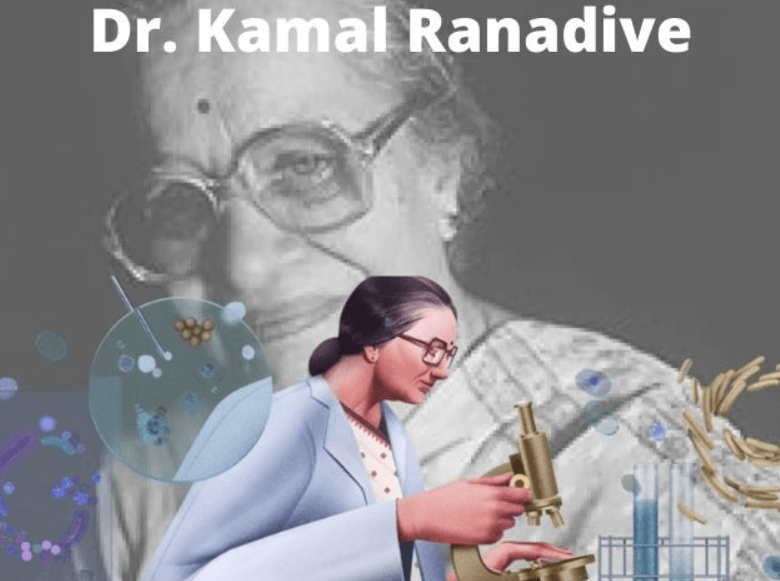
Dr. Kamal Ranadive and the Cancer Virus Link
A Big Leap in Healthcare Research
The connection between viruses and cancer wasn’t yet widely accepted in the mid 20th century. But Dr Kamal Ranadive ventured into this territory, theorizing that some viruses would prompt cancerous growth. Her work laid the groundwork for later discoveries, investigating, among other things, the role of human papillomavirus (HPV) in cervical cancer and hepatitis viruses in liver cancer.
Why This Work Mattered
And her discoveries weren’t merely theoretical. They were the first steps toward medical “translations”:
Understanding cancer causes beyond genetics
Development of cancer-prevention vaccines
Novel avenues for cancer therapy research
When we speak today of virus-related cancers, we trace our steps back to the one she had already taken.
Chief Contributions of Dr Kamal Ranadive
Enhancing Cancer Biology in India
Dr Ranadive was one of the pioneers in introducing tissue culture to cancer research in India. This breakthrough allowed cancer cells to be grown and studied outside the human body, paving the way for new experiments and treatments.
Studies on Breast Cancer and Leukemia
Her research delved deeply into breast cancer and leukemia, two of the most urgent issues in oncology. She looked at cellular patterns, influences of the environment, and heredity that could impact cancer risk. 7 These studies were used as a basis to develop prevention strategies for decades to come.
Establishing institutions for the future
She was not just a researcher; she was a builder. Dr Ranadive was instrumental in setting up of Indian Cancer Research Centre (now known as ICRC) and grooming the budding researchers. Many of her students became leaders in biomedical research, spreading her influence far beyond her own career.
Humanitarians Out of the Lab
Health Outreach in Rural India4
Dr Kamal Ranadive was unlike many scientists of her time in that she felt science needed to be accessible to ordinary people. She devoted considerable time to rural health schemes, concentrating especially on women and children. For her work in propagating hygiene, nutrition, and cancer prevention in villages, she was quite ahead of her time.
Championing Women in Science
One of her most cherished accomplishments remained the co-founding of the Indian Women Scientists’ Association (IWSA). Such a networking structure allowed for women to support each other in research, education, and professional development. And to this day, IWSA is her legacy, leading the way for women to surge into male-dominated STEM professions.
Awards and Recognition
Honors Received
That was not to say that Dr Kamal Ranadive’s work went unappreciated. In 1982, she was awarded the Padma Bhushan, one of India’s highest civilian honors.
Global Respect
Her research also drew international attention, catapulting Indian cancer research on the global stage. But the institutions she helped create and the discoveries she contributed to guaranteed that her name would be remembered in the global scientific community.
10 Facts About Dr Kamal Ranadive That Will Inspire You
In honor of her incredible journey, here’s a roundup of 10 fascinating facts:
She was born in Pune in 1917 and had to contend with discrimination against women studying science.
Cytology Paying guest with Dr V.R. Khanolkar.
Helped to establish the field of investigating the connection between cancer and viruses.
Pioneered the use of tissue culture in the field of Indian biomedicine.
Concentrated on breast cancer and leukemia.
Was instrumental in setting up the Indian Cancer Research Centre (ICRC).
Was co-founder of the Indian Women Scientists’ Association (IWSA).
Committed herself to rural health projects for women and children.
Awarded Padma Bhushan in 1982.
He left a legacy that has continued to maintain the direction of cancer research in India.
Conclusion: Remembering Dr Kamal Ranadive
The tale of Dr Kamal Ranadive is not a typical scientist’s biography. It’s a tale of smashing through barriers and pushing beyond boundaries. And proving, once again, that while development can be delayed no longer, science knows no limits. Her groundbreaking work in understanding the link between the virus and cancer, as well as establishing cancer research in India, and tirelessly advocating for women and rural communities, earns her a place among the likes of icons.
Yet her trip continues to inspire millions of students and scholars around the globe. She reminds us that enlightenment without empathy is incomplete, and that science sans humanity is inhumane.